


Related Posts
- ▶ Choosing a Chain Block for Low-Headroom Lifts: Capacity and Clearance
- ▶ Manual Pallet Truck Not Lifting? Hydraulic Faults and Practical Checks
- ▶ Lifting Tools for Machinery Installation Where Crane Access Is Limited
- ▶ Lifting Gear and Rigging Equipment Explained: Roles in a Typical Crane Lift
- ▶ Toe Jacks vs. Machinery Skates: Which Tools Does Your Machine Move Need?
- ▶ Why Does a Chain Block Slip Under Load? Brake Faults and Safe Next Steps
Send Us A Message
Lifting Gear and Rigging Equipment Explained: Roles in a Typical Crane Lift
Lifting Gear and Rigging Equipment Explained: Roles in a Typical Crane Lift
A crane provides the lifting power, but the connection to the load determines how that power is applied. Lifting gear and rigging equipment connect the crane hook to the material being moved. Slings support or attach to the load, shackles join components, and lifting beams help manage the geometry of the lift.
That distinction matters in a workshop. An overhead crane may have enough capacity to lift a machine assembly, yet an unsuitable sling arrangement can still damage the assembly or overload part of the rigging. Understanding the load path is more useful than simply knowing the names of the accessories.
Follow the load path from hook to material
In a common arrangement, the crane hook supports a master link connected to a multi-leg sling. The sling legs run down to shackles fitted through designated lifting points. Each connection transfers force to the next component, so compatibility matters as much as the capacity marked on individual items.
Not every lift uses this arrangement. A sling may pass around a load in a basket or choker hitch, or a lifting beam may sit between the hook and lower slings. The correct arrangement depends on the load’s shape, strength, lifting points, and center of gravity.
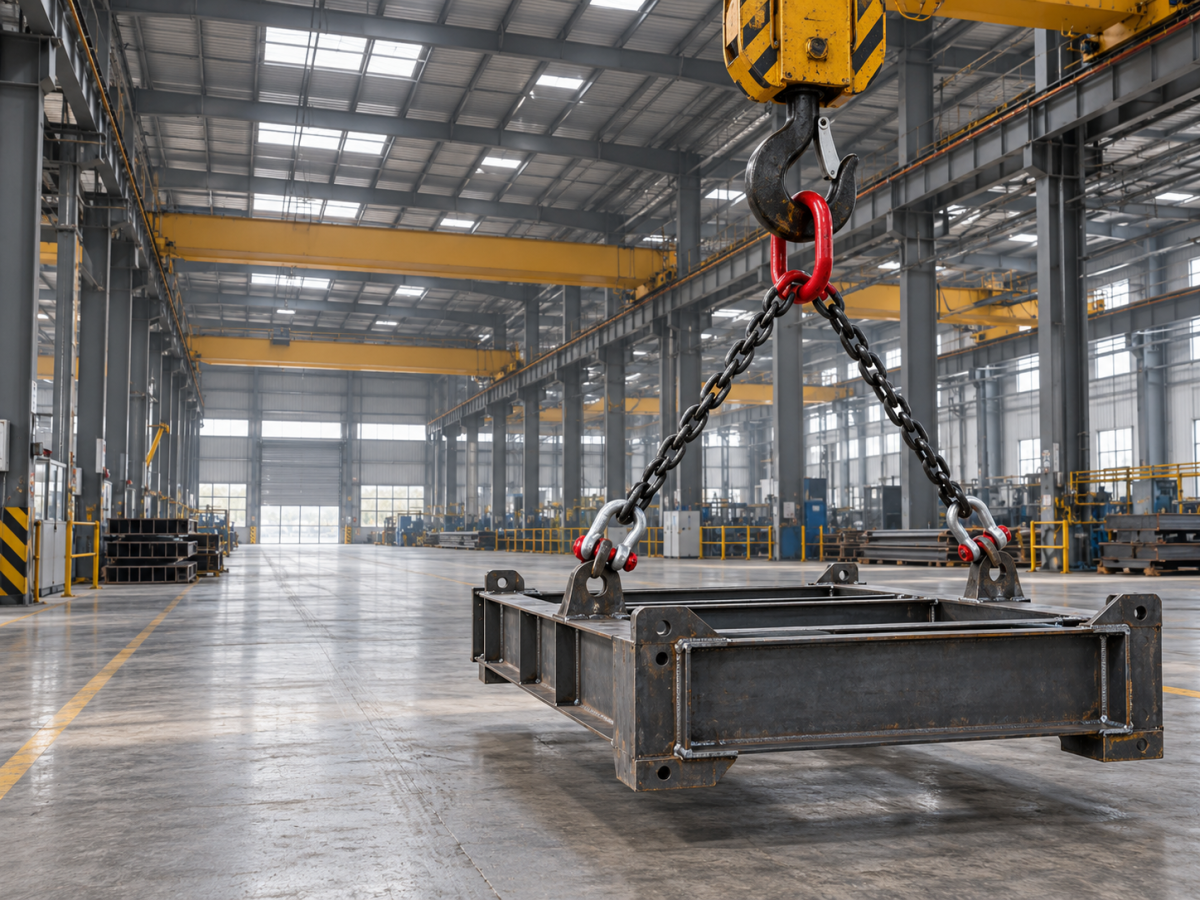
The hook should carry the attachment in its bowl, not on its tip. A hook latch helps retain an attachment; it is not a load-bearing substitute for correct seating. An oversized master link or crowded connection can prevent proper seating even when the marked capacities appear adequate.
What the main components actually do
- Slings: Provide flexible connections to the load. Chain, wire rope, and synthetic slings have different limits for temperature, chemicals, abrasion, and bending. Synthetic slings need suitable protection against damaging edges.
- Shackles: Connect sling eyes, lifting lugs, and other attachments. Pin fit, loading direction, and the manufacturer’s instructions matter; side loading can require capacity reductions or may be unsuitable.
- Lifting beams: Provide spaced lower attachment points, often helping keep lower slings vertical. Their bending strength and permitted attachment positions govern their use.
- Spreader beams: Typically work mainly in compression between upper sling connections. They can reduce inward forces on a load, but the upper rigging needs headroom.
Why load weight alone is not enough
Consider a long fabricated frame lifted from two points. As sling legs become flatter, tension increases and the inward force at the lifting points grows. A frame that can carry its own weight may not tolerate that squeezing force. A suitable beam arrangement can change those forces, but it also adds weight below the hook.
Sling-angle conventions need attention: an angle measured from horizontal means something different from one measured from vertical. Use the angle definition and capacity chart supplied for the equipment rather than relying on an unexplained angle value.
Working load limit, or WLL, applies under specified conditions. Hitch type, angle, temperature, and connection geometry can change the allowable load. Nor should a four-leg sling automatically be treated as four equally loaded legs; load stiffness, tolerances, and center-of-gravity position affect load sharing.
The crane must also accommodate the applicable total suspended load, including below-hook equipment. A heavy beam can consume capacity that was overlooked when only the material weight was checked.
The practical checks before the load leaves the floor
A lifting point should be designed for the intended force and direction. Convenient holes, transport brackets, and welded tabs are not automatically suitable lifting points. Where drawings or ratings are missing, the uncertainty needs resolving—not compensating for with a larger shackle.
Pre-use inspection should cover identification and condition: illegible capacity markings, sling cuts, damaged stitching, distorted links, cracked fittings, or damaged shackle threads require action under the applicable inspection criteria. Periodic examination requirements depend on equipment, service conditions, and local rules.
A controlled initial lift just clear of the support surface allows trained personnel to check balance and seating from a safe position. It does not prove capacity or replace planning. Unexpected tilt, movement, or uneven tension is a reason to lower the load and reassess—not adjust rigging while it remains suspended.
For operations using overhead cranes, gantry cranes, and electric hoists, such as those supplied by Baoding Luoxiang Lifting Equipment Co., Ltd., rigging selection belongs alongside crane selection. Available headroom, the travel route, and the landing position all influence the arrangement. Before choosing a sling or beam, establish the load weight, center of gravity, and approved lifting points; those facts determine what the connection needs to do.
- Previous Article:No more articles
- Next Article:No more articles