


Related Posts
- ▶ Choosing a Chain Block for Low-Headroom Lifts: Capacity and Clearance
- ▶ Manual Pallet Truck Not Lifting? Hydraulic Faults and Practical Checks
- ▶ Lifting Tools for Machinery Installation Where Crane Access Is Limited
- ▶ Lifting Gear and Rigging Equipment Explained: Roles in a Typical Crane Lift
- ▶ Toe Jacks vs. Machinery Skates: Which Tools Does Your Machine Move Need?
- ▶ Why Does a Chain Block Slip Under Load? Brake Faults and Safe Next Steps
Send Us A Message
Lifting Tools for Machinery Installation Where Crane Access Is Limited
Lifting Tools for Machinery Installation Where Crane Access Is Limited
When overhead clearance is tight, access routes are narrow, or a crane cannot reach the installation point, moving heavy machinery becomes a planning challenge—not just a lifting task. A machine may arrive easily at the loading bay yet still face a difficult journey through a doorway, around a column, and onto its foundation. Compact hoists, portable gantries, toe jacks, and machinery skates can bridge those gaps, but each solves a different part of the move.
The practical approach is to separate unloading, horizontal travel, positioning, and final lowering. Trying to make one tool handle every stage often creates the awkward—and potentially unsafe—part of the installation.
Survey the route, not just the installation footprint
Start with verified machine weight, overall dimensions, center of gravity, and manufacturer-approved lifting or jacking points. Shipping weight may include packaging or accessories; an operating machine may contain fluids or attached assemblies. Confirm which configuration will actually be moved.
Then walk the full route. Door height alone is not enough: the machine’s transport height includes skates, support arrangements, and any protruding components. At corners, check the swept path rather than assuming that a machine narrower than the aisle will turn through it.
- Check floor capacity for concentrated wheel and jack reactions, not only the machine’s final distributed load.
- Identify trenches, service covers, joints, slopes, and damaged concrete along the travel path.
- Measure usable lifting clearance, including the hoist body, trolley, rigging, and required lift height.
- Confirm space to withdraw skates and jacks after the machine reaches its foundation.
Where slab details or underground services are uncertain, obtain an engineering assessment before selecting the handling arrangement. A higher-capacity jack does not make an unsuitable floor safe.
Match Other Lifting Tools to the stage of the move
Toe jacks for restricted pickup clearance
Toe jacks suit machines with little clearance beneath the base, provided the machine has suitable load-bearing jacking points. Check the rated capacity at the toe itself; some models have different toe and head ratings. Available stroke, toe dimensions, and the condition of the supporting floor also matter. Do not assume several jacks will share weight equally, particularly with an offset center of gravity.
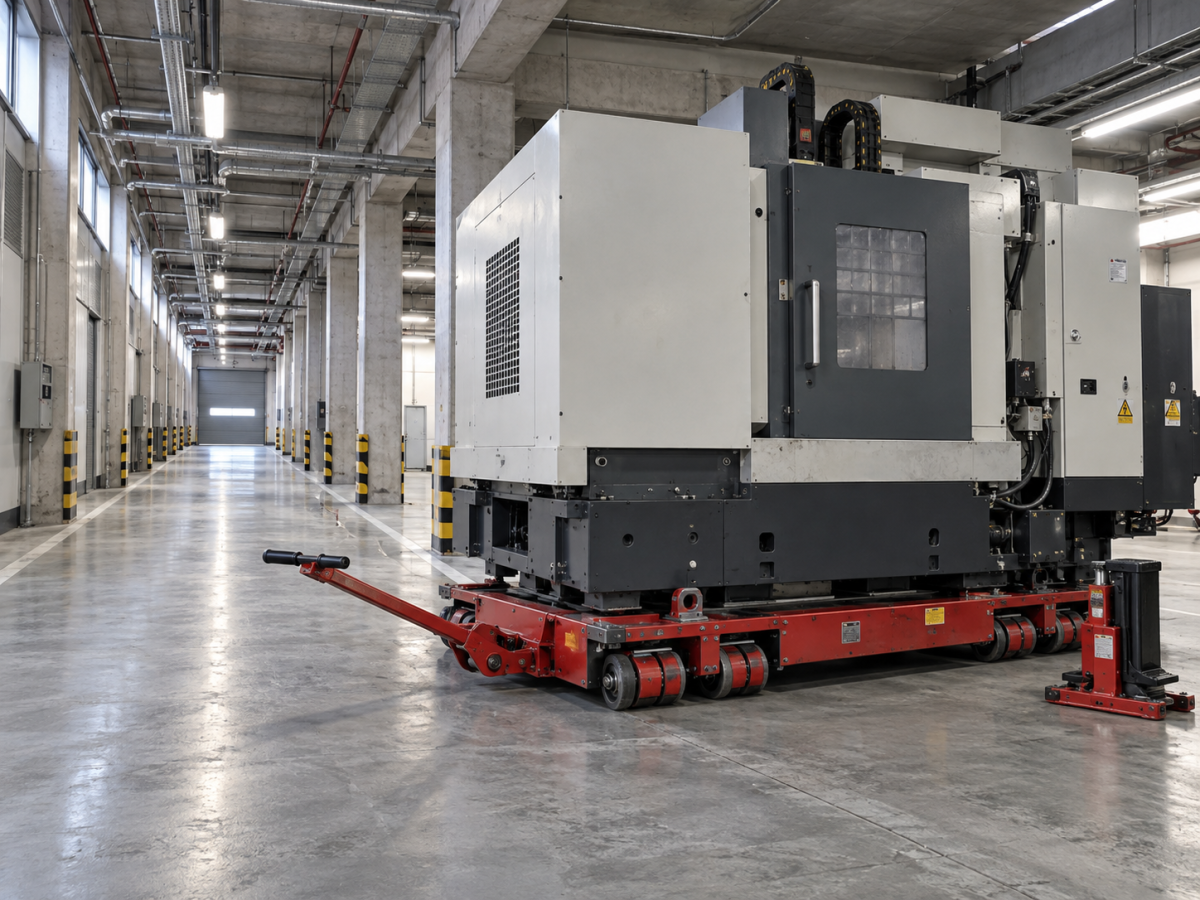
Machinery skates for horizontal movement
Skates are useful on suitable, level floors when a suspended load is unnecessary. Selection depends on load distribution, wheel material, steering geometry, and surface condition—not simply total rated capacity. Small wheels can struggle at joints or debris that appears insignificant during a walk-through. Slopes require a separately engineered movement and restraint method; ordinary skates should not be treated as a braking system.
Portable gantries and compact hoists for local lifting
A portable gantry can provide a lifting point where an overhead crane cannot reach, but its legs may compete with the machine, foundation, or access aisle for floor space. Check the complete lifting arrangement: beam clearance, hoist headroom, sling geometry, and support reactions. Moving a gantry with a suspended load is acceptable only where the manufacturer permits it and the specified conditions are met.
A compact electric or manual hoist still needs a verified supporting structure. An available roof beam is not automatically an approved lifting point, and a hoist should not be side-pulled to compensate for poor positioning.
Plan the handovers before equipment arrives
The vulnerable moments are often transitions: transferring from delivery equipment to skates, changing direction near a doorway, or removing transport supports above a foundation. The lift plan should define stable support at each handover, exclusion zones, communication, and who controls movement. Nobody should enter beneath an unsupported load or use hands to check alignment in a pinch point.
Final positioning deserves its own equipment allowance. Machinery skates provide transport, not precision leveling. Depending on the machine, approved leveling screws, suitable positioning equipment, and alignment instruments may be needed before anchoring.
Baoding Luoxiang Lifting Equipment Co., Ltd. supplies overhead cranes, gantry cranes, electric hoists, pallet trucks, and related material-handling equipment. For a restricted-access installation, a useful enquiry should include the route drawing, machine details, floor information, and final positioning requirements. A pallet truck may suit a compatible palletized delivery, for example, but that does not establish its suitability beneath an unpacked machine.
Before booking the installation date, have the responsible lifting specialist verify the weakest stage of the route—not merely the largest item of equipment on the list.
- Previous Article:No more articles
- Next Article:No more articles