


Related Posts
- ▶ Choosing a Chain Block for Low-Headroom Lifts: Capacity and Clearance
- ▶ Manual Pallet Truck Not Lifting? Hydraulic Faults and Practical Checks
- ▶ Lifting Tools for Machinery Installation Where Crane Access Is Limited
- ▶ Lifting Gear and Rigging Equipment Explained: Roles in a Typical Crane Lift
- ▶ Toe Jacks vs. Machinery Skates: Which Tools Does Your Machine Move Need?
- ▶ Why Does a Chain Block Slip Under Load? Brake Faults and Safe Next Steps
Send Us A Message
Toe Jacks vs. Machinery Skates: Which Tools Does Your Machine Move Need?
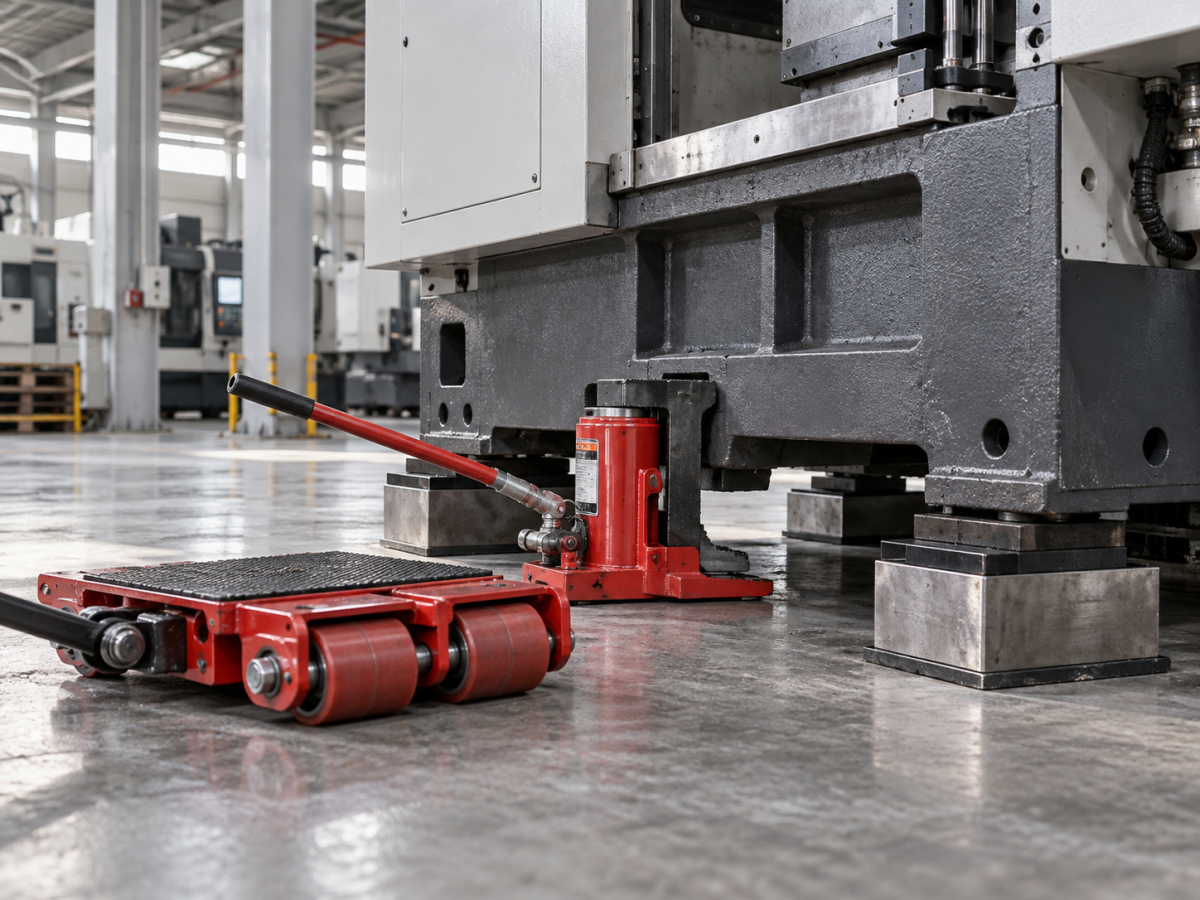
Choose toe jacks when a machine needs to be raised from a low pickup point; choose machinery skates when it needs to travel horizontally across a suitable floor. Many moves require both: the jack creates clearance, and the skates support the machine during travel. The deciding factors are the machine’s lifting points, load distribution, available clearance, and travel route—not simply its total weight.
Match the tool to the movement required
If the machine already stands on suitable transport supports with sufficient clearance, skates could be installed without toe jacks. If the work only involves raising a machine for leveling or inserting supports, skates add no useful function. When neither tool can engage a structurally suitable point, a different lifting arrangement is required.
A toe that fits underneath may still be unsuitable
Minimum toe height is only the first dimension to compare. The toe also needs sufficient engagement beneath a lifting point that can carry the concentrated force. Sheet-metal guards, leveling screws, and unsupported edges are unsuitable unless the machine manufacturer explicitly identifies them for lifting.
The jack body and base need clearance as well. A low toe is of little use if the base cannot sit fully on a firm, level surface or the body contacts the machine before engagement is complete. Compare usable stroke with the lift needed to install the skates and any specified load-spreading components, while maintaining the jack’s permitted engagement geometry.
Use the capacity stated for the actual lifting surface. Some jacks have different ratings for the toe and head. A prominent capacity marking should not be assumed to apply equally to both. Hydraulic jacks also require appropriate independent support before work beneath a raised load; hydraulic pressure alone is not a secure support arrangement.
Load distribution changes both selections
Dividing machine weight by the number of jacks or skates assumes equal load sharing. That assumption fails when a motor, gearbox, or other heavy assembly places the center of gravity away from the geometric center. Support positions and structural stiffness also affect the load carried at each point.
For example, a machine with a heavy drive assembly at one end can place substantially more load on the skates beneath that end. Selecting every skate from an equal quarter-share of the total weight leaves that imbalance unaccounted for. Establish the support reactions from reliable machine information or an engineered assessment, then apply the equipment manufacturer’s selection requirements.
Multiple independent jacks introduce another issue: equal handle movements do not guarantee equal lifting heights. Uneven lifting changes support reactions and tilts the machine. The lifting arrangement must control this movement within the machine’s permitted limits.
The floor and turns often decide the skate arrangement
A skate’s rated capacity does not establish whether the route is usable. Small rollers encounter high resistance at floor joints, debris, damaged concrete, and abrupt level changes. These features can stop a roller while the applied moving force continues to act on the machine, increasing instability.
Evaluate floor bearing capacity along the entire route, including covers, trenches, and suspended slabs. Roller material also matters: steel rollers concentrate contact pressure, while polyurethane rollers have their own limits for loading, surface condition, and rolling resistance. A floor finish alone does not establish compatibility.
Steering requires more than a steerable front unit. The machine’s footprint, support spacing, rear-skate behavior, and swept path determine whether it can negotiate a corner. A connecting bar maintains spacing only as specified by its design; it should not be assumed to secure the machine or equalize loads.
Skates also need a suitable means of applying and controlling travel force. A steering handle is not automatically an approved towing connection or brake. Any gradient requires equipment and a restraint arrangement explicitly suitable for that condition.
Resolve the transfer before selecting the equipment
The critical interface is the transfer from jack to skate. The jack must raise the machine far enough for insertion, the skate must contact an approved support area, and lowering must leave the load stable. Confirm that the jack can then be withdrawn without disturbing the skate. Repeat this assessment at the destination, where final positioning or leveling feet may restrict access.
When comparing these with other lifting tools, select around that complete sequence. A jack with adequate capacity but insufficient usable lift, or a skate arrangement that cannot be removed at the final position, leaves the move incomplete.
- Previous Article:No more articles
- Next Article:No more articles