


Related Posts
- ▶ Choosing a Chain Block for Low-Headroom Lifts: Capacity and Clearance
- ▶ Manual Pallet Truck Not Lifting? Hydraulic Faults and Practical Checks
- ▶ Lifting Tools for Machinery Installation Where Crane Access Is Limited
- ▶ Lifting Gear and Rigging Equipment Explained: Roles in a Typical Crane Lift
- ▶ Toe Jacks vs. Machinery Skates: Which Tools Does Your Machine Move Need?
- ▶ Why Does a Chain Block Slip Under Load? Brake Faults and Safe Next Steps
Send Us A Message
Choosing a Chain Block for Low-Headroom Lifts: Capacity and Clearance
Select a chain block only after confirming that its rated capacity and installed dimensions satisfy the same lifting arrangement. A unit with sufficient capacity can still leave the load too low to clear its mounting studs, pass over an obstruction, or reach its final position. For a low-headroom lift, the decisive dimension is the minimum distance between the suspension reference and the load hook bearing point, including the hardware needed to attach the hoist to its support.
Establish the load before comparing hoist sizes
The suspended load includes the component and everything carried below the load hook: slings, shackles, lifting beams, and temporary attachments. Use a verified weight or a defensible calculation. Residual liquid, attached tooling, and an uncertain center of gravity require resolution before selecting the capacity.
Choose a rated capacity that covers this total under the intended operating conditions. Do not treat the hoist’s internal design allowance as extra working capacity. Where application requirements call for additional capacity, apply those requirements explicitly rather than assuming a universal percentage.
Increasing capacity also changes the clearance calculation. A larger model can have a taller body, a larger hook block, or additional load-chain falls. Compare the actual dimensions of eligible models; capacity alone does not establish which one fits.
A component that remains bolted, seized, or pressed into place presents a separate problem. Its weight does not establish the force needed to release it. Resolve the removal method before sizing the lifting equipment, and keep the chain aligned with the permitted lifting direction. Side pulling is unsuitable unless the equipment is specifically designed and approved for it.
Build the clearance calculation from fixed reference points
Start with the available height from the supporting structure to the highest position the component’s lifting point must reach. Include any extra rise needed to disengage locating pins or clear nearby equipment. Then account for each item occupying that space.
Required vertical space = support connection depth + minimum hoist headroom + loaded rigging height + necessary clearance allowance.
This relationship works only when the dimensions use consistent reference points. If the manufacturer’s installed headroom already includes the trolley or suspension assembly, do not add that assembly again.
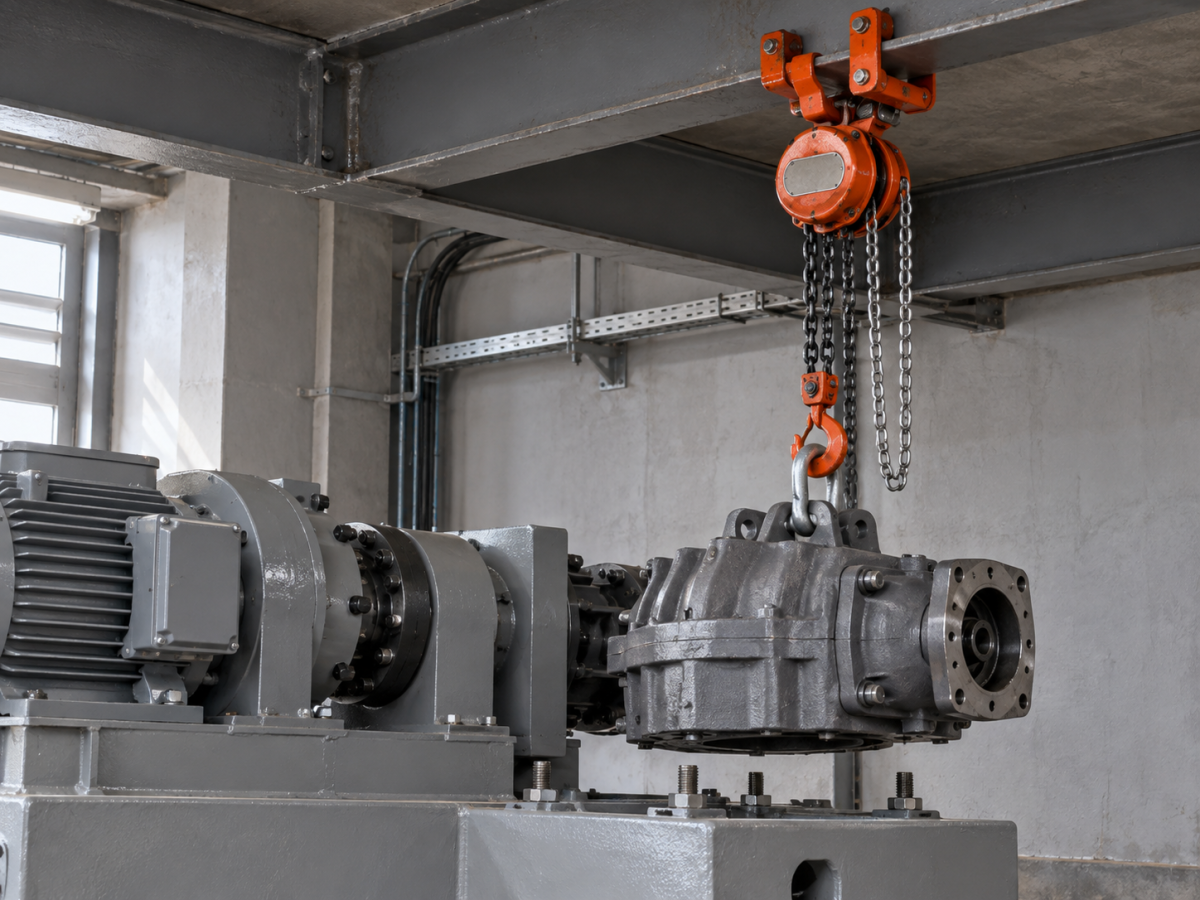
For a hook-suspended chain block, minimum headroom commonly refers to the distance between the upper and lower hook bearing points with the lower hook at its highest permitted position. Confirm the drawing’s definition. An overall body dimension or an unlabeled catalog dimension cannot substitute for this measurement.
Loaded rigging height extends from the lower hook bearing point to the component’s lifting reference. Sling angle, shackle position, and lifting-beam geometry affect it. Shortening slings to recover height increases sling-leg tension when it produces a wider angle from vertical, so any revised arrangement needs its own rigging assessment.
Allow space for controlled positioning and hook removal. A layout that fits only with the hook at its upper travel limit offers no allowance for installation tolerances, support deflection, or the movement needed to disconnect the rigging.
Headroom and lifting height answer different questions
Minimum headroom establishes the highest reachable hook position. Rated lift establishes the available hook travel. Both must work: a compact hoist may fit above the component yet have insufficient chain length to reach the pickup point.
Specify lift using the actual pickup and placement elevations, including intermediate clearance movements. Extra load chain does not reduce minimum headroom. It also introduces chain-management requirements: loose chain must remain clear of the load and machinery, and any chain container must fit throughout the movement.
When a low-headroom arrangement changes the result
If a conventional suspended unit fails the vertical calculation, compare an integrated low-headroom trolley hoist or another purpose-designed arrangement. Locating parts of the mechanism beside the beam can reduce installed height. Confirm the complete assembly dimensions rather than relying on the “low-headroom” description.
The tradeoff can be greater lateral space, different wheel loads, or a different approach distance near beam ends. Beam flange width, flange thickness, profile compatibility, and trolley adjustment range must match the actual runway. A compact vertical envelope is useful only if the assembly can travel and position the hook where required.
The support assessment must include the hoist and trolley self-weight as well as the suspended load, with applicable operating effects. Verify the beam, connections, and supporting structure for the proposed loading arrangement; a beam’s physical ability to accept a trolley does not establish its lifting capacity.
Before final selection, place the candidate’s dimensioned drawing against a measured layout showing pickup, obstruction-clearance, and placement positions. Where clearance is tight, confirm tolerances and deflection with the equipment supplier and structural assessment. Any remaining interference must be resolved through the lifting arrangement or installation geometry before the lift proceeds.
- Previous Article:No more articles
- Next Article:No more articles